

Hospitalist Billing Services
Your Hospitalist Group Touches Every Patient in That Building. Your Billing Should Reflect That.
Hospitalist billing is one of the most volume-intensive, documentation-dependent billing environments in all of medicine. Admission, daily rounds, critical care, and discharge each encounter generates a separate claim, each one with its own coding rules, documentation thresholds, and denial patterns that most billing teams never fully master. The average hospitalist group loses $200 to $600 per patient admission to a combination of undercoded E/M levels, missed critical care billing, incorrect discharge coding, and observation versus inpatient classification errors. Multiply that by your annual volume and the number becomes difficult to ignore.
Measurable Revenue Outcomes for Hospitalist Practices
.png)


< 30
97%
12–18%
99%
98%
Average Days in AR
Collection Ratios
Revenue Improvement
First Pass Ratio
Clean Claims Accuracy
Full-Cycle Hospitalist RCM
Our Hospitalist Billing Services Precision at Every Encounter
We handle every stage of your revenue cycle so you can stay focused on managing liver disease not chasing down unpaid claims or wondering why your collections are lower than they should be.We manage every stage of hospitalist revenue cycle management with the specificity that high-volume inpatient billing demands from pre-admission eligibility through final payment, nothing is left to generalist assumptions.

Eligibility Verification & Payer Pre-Clearance
We verify insurance eligibility before every admission confirming Medicare inpatient benefit availability, checking Medicare Advantage inpatient authorization requirements, and identifying any managed care plans that require notification within 24 to 48 hours of admission. Catching a coverage issue on day one prevents the far more expensive problem of discovering it on day five when a claim is already in the queue.

Inpatient E/M Coding & Level Optimization
Our AAPC certified coders review every hospitalist encounter note and select the E/M level based on a complete analysis of the documented MDM components problem complexity, data reviewed, and risk or total time when that supports a higher level. We don't default to middle codes because they feel safe. We code to what the documentation actually supports, and we identify the documentation gaps that are costing the group revenue before the pattern becomes a systemic problem.

Critical Care Billing & Time Documentation
We track every encounter where the clinical picture suggests critical care services were provided septic shock, respiratory failure, acute MI management, multi-organ dysfunction and audit the note for time documentation before the claim is submitted. When time isn't documented but the clinical scenario clearly reflects critical care work, we flag the encounter for physician clarification so the billing accurately reflects what happened in the room, not just what ended up in the note.

Discharge & Observation Code Accuracy
We review discharge documentation for time and apply 99238 or 99239 based on what's actually documented. For observation encounters, we apply the correct observation codes, review inpatient versus observation status consistency, and flag cases where the two-midnight rule supports inpatient admission but the status was set to observation allowing for status corrections before billing locks the encounter into the wrong category.

Split/Shared Visit Compliance Management
We review every encounter where an APP and an attending physician both participated in the patient's care on the same date, apply the current CMS substantive portion criteria to determine the correct billing provider, and ensure the documentation supports the billing assignment. This is one of the most frequently non-compliant areas in hospitalist billing under the current guidelines, and our systematic review protects your group from the overpayment exposure that comes with getting it wrong consistently.
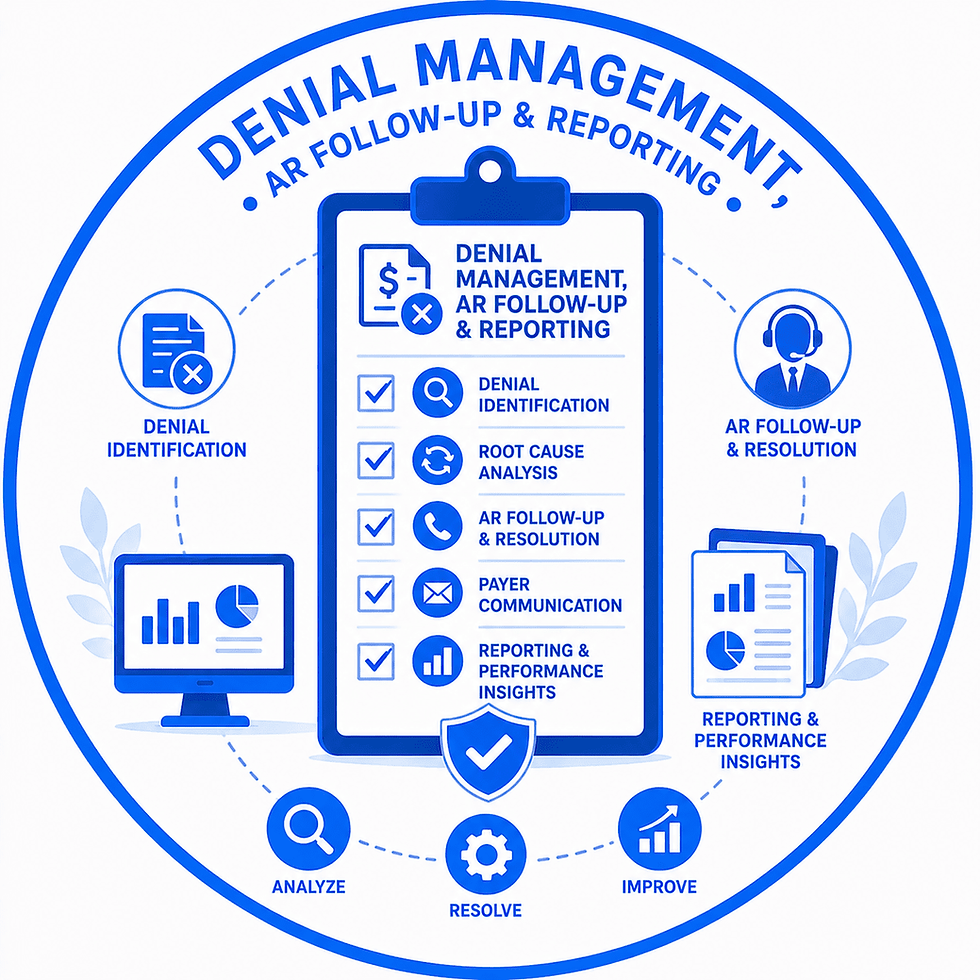
Denial Management, AR Follow-Up & Reporting
We investigate every inpatient denial at the root medical necessity challenges, observation versus inpatient disputes, E/M level downgrades, and coordination of benefits issues and build complete, evidence-based appeals. Our AR follow-up system prioritizes by dollar value and denial age so nothing sits in queue past its appeal window. Monthly reporting gives you collections by provider, denial trends by code and payer, and E/M distribution analysis across the group.
Why Hospitalist Groups Choose MedCloudMD
✔ AI-Driven Billing That Maximizes Every Claim
✔ Hospitalist Billing Is a Core Specialty, Not a Secondary Service
✔ We Optimize E/M Levels — We Don't Just Process Notes
✔ Significantly Reduced Days in AR
✔ Provider-Level Transparency, Not Just Group-Level Reports
✔ One Dedicated Account Manager Who Understands Your Group
✔ Seamless EHR & Practice Management Integration


Where Hospitalist Groups Are Quietly Losing Revenue Every Admission

The initial hospital care codes 99221 through 99223 carry meaningfully different reimbursement levels. The difference between billing a 99221 and a 99223 on a complex admission can be $120 to $180 per encounter, depending on the payer. When a hospitalist admits a patient with sepsis, multiple comorbidities, and a complex medication history, that visit likely meets the criteria for 99223 but many billing teams default to 99222 out of habit or uncertainty, and the revenue loss compounds across every admission in the year.
Critical Care Never Billed When It Should Be
Critical care (99291 and 99292) requires documentation of total time spent in direct patient care for a critically ill or injured patient and that time must be explicitly documented in the note, not inferred from the visit description. Hospitalists who spend 35, 45, or 60 minutes providing critical care and document the clinical decisions but never write down the total time are systematically losing critical care revenue because the claim gets coded as a subsequent hospital visit instead. For high-volume groups with ICU responsibilities, this is often the single largest revenue recovery opportunity in the billing audit.
Discharge Coding Defaulting to 99238 Instead of 99239
Discharge day management is either 99238 (30 minutes or fewer) or 99239 (more than 30 minutes). For patients who require lengthy discharge coordination, medication reconciliation discussions, family conversations, and complex disposition planning, the encounter often takes 40 or 50 minutes. But when notes don't document discharge time, 99238 gets billed automatically even for discharges that clearly meet the 99239 threshold. The reimbursement difference per encounter isn't enormous, but across hundreds of discharges per month, the revenue gap is very real.
Observation vs. Inpatient Misclassification
When a patient is placed in observation status but the documentation, clinical picture, and length of stay actually support inpatient admission under the two-midnight rule, billing the encounter under the lower-paying observation framework costs the group real money per case. It also creates confusion around Medicare beneficiary cost-sharing obligations. The reverse problem billing inpatient admission codes for what should be billed as observation creates overpayment exposure. Both are billing problems. Both are avoidable with the right review at the point of coding.
Split/Shared Visit Billing Applied Incorrectly
Under the 2022 CMS split/shared visit rules, when an attending physician and an APP both see the same inpatient on the same date, the billing depends on which clinician performs the substantive portion of the visit now defined primarily by total time. Billing the encounter under the attending when the APP performed the majority of the visit, or vice versa, creates both a revenue problem and a compliance issue. Many hospitalist groups haven't fully updated their split/shared billing workflow to the current CMS definition, which means every joint APP/physician visit is a potential compliance exposure point.
MDM Underdocumentation Forcing Lower E/M Levels
Under the 2023 E/M guidelines, Medical Decision-Making for inpatient coding is assessed across three elements: the number and complexity of problems addressed, the amount and complexity of data reviewed and analyzed, and the risk of complications or mortality. Hospitalist notes that thoroughly describe the clinical picture but fail to document data review external records reviewed, labs ordered and analyzed, specialist discussions are forced into lower E/M levels than the clinical complexity of the visit actually justifies, simply because the documentation doesn't spell it out.
AI-Powered Hospitalist Billing That Catches What Manual Review Misses
MedCloudMD's AI platform works across your entire hospitalist revenue cycle surfacing E/M optimization opportunities, flagging critical care documentation gaps, predicting denial patterns before claims are submitted, and prioritizing AR follow-up where the dollar return is highest.
Critical Care Documentation Flagging

AI identifies encounters where the clinical diagnosis, procedures performed, and physician activity suggest critical care services were provided then checks whether total time was documented in the note. When a sepsis management note or respiratory failure encounter doesn't include time documentation, the system flags it for physician clarification before the claim is coded as a 99232 instead of a 99291 that the encounter actually justifies.
E/M Level Optimization Suggestions

Our AI engine analyzes each hospitalist note against the 2023 MDM framework evaluating problem complexity, data review documentation, and risk level and generates E/M level suggestions based on what the documentation actually supports. When a note qualifies for a higher level but time isn't documented and MDM elements are understated, the system flags it for physician addendum rather than silently defaulting to a lower code.
Predictive Denial Prevention

AI cross-references every hospitalist claim against current payer-specific inpatient billing policies, Medicare medical necessity criteria, and E/M documentation requirements before submission. Claims that carry denial risk based on coding pattern analysis, documentation gaps, or payer behavior history are flagged and corrected before they leave the system stopping the most common hospitalist denials before they happen.
Group-Level Analytics & Provider Benchmarking

Your monthly analytics include E/M level distribution by provider showing you where individual hospitalists are coding relative to their peers and relative to expected patterns given patient acuity. Outliers on either end of the distribution tell a story: either a documentation coaching opportunity or a compliance concern. Our analytics surface both before they become a problem.
Split/Shared Visit Compliance Monitoring

AI identifies every encounter where both an APP and an attending physician are documented as having seen the patient on the same date, then applies the current CMS substantive portion criteria to verify that the claim is attributed to the correct billing provider based on who performed the majority of the visit. This systematic review runs on every applicable encounter rather than relying on individual coder awareness of which visits need this evaluation.
Smart AR Follow-Up Prioritization

Our AI ranks your aging hospitalist claims by dollar value, payer responsiveness patterns, and denial category so your billing team's follow-up time is concentrated on the claims most likely to generate the highest recovery. Given the volume of inpatient claims a hospitalist group generates, manually prioritizing AR follow-up is both inefficient and error-prone. Our system handles the prioritization so nothing high-value ages out unworked.
Hospitalists Generate More Billable Encounters Per Patient Than Almost Any Other Specialty
Think about a patient admitted on Monday with pneumonia and discharged on Thursday. That's an initial hospital care visit on day one (99221–99223), a subsequent hospital care visit on each of Tuesday and Wednesday (99231–99233), and a discharge day management service on Thursday (99238 or 99239). Four separate claims, four separate coding decisions, four separate opportunities for a billing error all from a single three-day admission.
Now consider that some of those patients become critically ill overnight. That changes the subsequent visit to a critical care claim 99291 for the first 30 to 74 minutes, with 99292 add-ons for each additional 30 minutes. If the physician spent 65 minutes providing critical care but the note doesn't document total time, the claim goes out as a 99291 and the add-on is lost. If the documentation doesn't use the specific language CMS requires to justify critical care, the entire claim gets downgraded to a 99232 on audit review.
That's before you factor in the observation versus inpatient status question one of the most consequential and most frequently wrong billing decisions in all of hospital medicine or the split/shared visit rules that apply every time an APP sees the patient on the same day as the attending physician. Hospitalist billing done well requires a level of daily coding precision that very few billing teams sustain consistently across a high-volume group.
Multiple Encounters Per Single Stay
Every admission generates a chain of separate, individually billable encounters — admission, daily rounds, critical care escalations, and discharge — each requiring its own documentation standard and coding decision. One weak link in that chain affects the revenue for the entire admission.
Inpatient E/M level selection under the 2023 CMS guidelines is driven by either medical decision-making complexity or total time — and hospitalists document a lot of patients in a short time. Notes that are thorough but vague on MDM components or don't document total time leave significant coding potential on the table.
Documentation Drives Every Dollar
The decision between observation and inpatient status isn't made by the billing team but it absolutely affects how billing proceeds. When the two-midnight rule isn't applied correctly by the admitting team, or when the documentation doesn't support inpatient admission criteria, the billing cascades into a category it shouldn't be in — and corrections are expensive and time-consuming.
Observation vs. Inpatient Status
When an NP or PA sees the patient and the attending physician also sees the patient on the same day, split/shared billing rules determine who bills and at what level. Getting this wrong either underbills the encounter or creates an overpayment situation — both of which create problems under a CMS audit.
Split/Shared Visit Complexity
.png)
.png)
.png)
.png)
.png)
.png)
.png)
.png)
Your Hospitalist Group Bills Thousands of Encounters a Month Make Sure Every One of Them Is Coded to Its Full Potential
Undercoded admissions, uncaptured critical care, default discharge codes, and unchecked split/shared billing aren't dramatic failures they're the quiet, repeating billing decisions that accumulate into six-figure annual revenue losses for hospitalist groups of every size. Our free billing audit finds every gap and puts a specific dollar value on each one, so you know exactly what you're working with before making any decision.

Frequently asked questions
- 01
- 02
- 03
- 04
- 05
- 06
- 07