
CPT Code 64633 and 64635: Cervical and Lumbar Radiofrequency Ablation Billing Guide for 2026

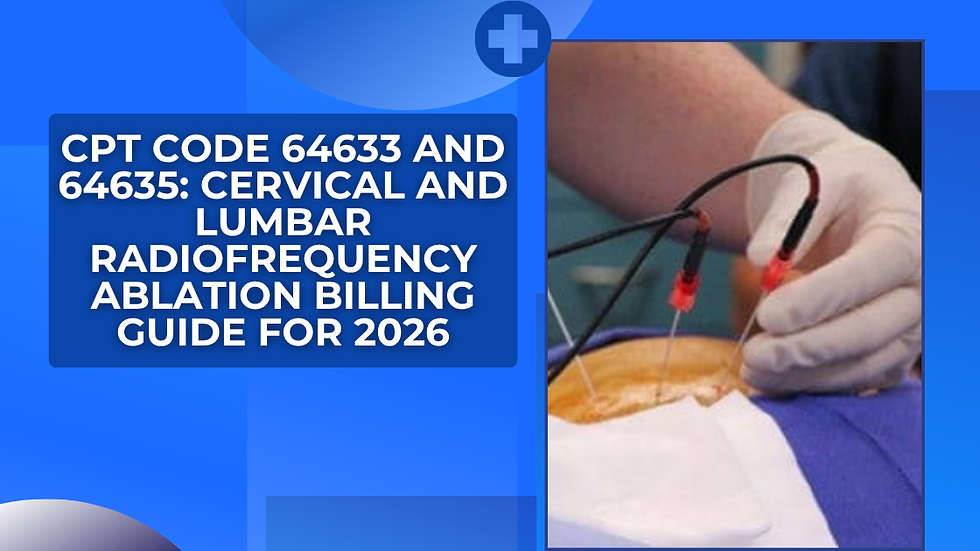
Radiofrequency ablation using heat to disrupt the medial branch nerves that carry facet joint pain is a common next step for patients who responded well to diagnostic facet injections. But the billing side splits cleanly along anatomy: CPT 64633 covers the cervical or thoracic spine, CPT 64635 covers the lumbar or sacral spine, and mixing up the region or the level count is one of the more preventable ways these claims go wrong.
Billing Snapshot CPT 64633: cervical or thoracic, single facet joint, thermal radiofrequency destruction with fluoroscopic or CT guidance. CPT 64635: lumbar or sacral, single facet joint, same technique. Both codes are reported per joint, not per nerve — even though two medial branch nerves typically innervate each joint, only one unit is billed per joint treated. Both codes apply only to thermal (heat-based) destruction; pulsed or non-thermal RF uses a different code entirely. |
CPT 64633 vs. CPT 64635
CPT Code | Anatomical Region | Key Billing Consideration |
64633 | Cervical or thoracic spine, single facet joint | Add-on code 64634 reports each additional cervical/thoracic joint |
64635 | Lumbar or sacral spine, single facet joint | Add-on code 64636 reports each additional lumbar/sacral joint |
These are two entirely separate code families — 64633/64634 for cervical/thoracic, 64635/64636 for lumbar/sacral. A procedure note documenting lumbar levels should never be billed with the 64633 family, and vice versa.
What Do CPT 64633 and 64635 Represent?
Both codes report thermal (heat-based) destruction of paravertebral facet joint medial branch nerves, performed with fluoroscopic or CT image guidance built into the code itself. They're billed per facet joint denervated — not per nerve, and not per needle pass — so a coder reviewing a two-level cervical RFA counts joints treated, not individual nerve targets, when selecting between the primary and add-on codes.
Compliance Check CPT guidance specifically states that these “destruction” codes should not be reported for non-destructive techniques, including pulsed radiofrequency or low-grade thermal energy under 80°C — those use CPT 64999 instead. Confirm the actual technique documented in the procedure note before selecting a code. |
Cervical vs. Lumbar RFA Billing
DO | CHECK | AVOID |
Verify the documented anatomical region and specific levels treated | Confirm the procedure note supports the exact code billed, including add-on units | Choosing a code based solely on the patient's diagnosis without reading the note |
Each unilateral or bilateral intervention at a given level is generally counted as one unit of service, with laterality reflected through modifier 50 (bilateral) or RT/LT (unilateral) rather than by doubling the unit count — but confirm this against the applicable payer's current billing guidance, since conventions can vary.
Documentation Checklist
☐ Correct procedure (thermal RFA, not pulsed or non-thermal) documented
☐ Anatomical region and specific facet joint levels clearly identified
☐ Laterality documented when applicable
☐ Medical necessity supported, including relevant prior treatment history where required
☐ Diagnosis appropriately linked to the procedure performed
☐ Required authorization verified, where applicable
☐ Modifier requirements reviewed against the specific payer's policy
☐ Units reviewed against joints treated, not nerves or needle passes
☐ Procedure note supports every element of the submitted claim
Documentation and authorization requirements vary by payer and by the applicable coverage policy — this is a starting framework, not a universal standard.
Modifiers and Claim Details
Modifiers should only be reported when the documented circumstances and applicable coding or payer rules actually support them — never applied as a default pattern. Relevant considerations for RFA claims include laterality (bilateral vs. unilateral), whether the service was billed on the professional or facility side, payer-specific modifier requirements, and NCCI edits between RFA codes and other same-day procedures. The correct modifier depends on the specific service, setting, and payer — verify current requirements rather than applying a fixed rule across every claim.
Medical Necessity and Documentation
Payers generally look for documentation connecting the patient's condition, prior treatment response (often including a documented positive response to diagnostic facet injections), the specific anatomical site, and the clinical rationale for proceeding with ablation. Some payer policies apply additional criteria — for example, certain coverage policies exclude RFA at a level with prior spinal fusion, or require a minimum interval since a previous RFA at the same level and side before a repeat procedure is covered. These specifics vary by payer, so verify the applicable policy rather than assuming one standard applies everywhere.
Common CPT 64633 / 64635 Billing Errors
Mistake | Why It Creates Risk |
Wrong anatomical code family selected | Cervical/thoracic and lumbar/sacral codes are not interchangeable |
Incomplete procedure documentation | Missing level or technique detail can't support the billed code |
Diagnosis doesn't adequately support the service | Increases medical necessity denial risk |
Unsupported or incorrect modifier | Can trigger a rejection or a compliance concern at audit |
Missing required authorization | Can result in outright non-payment regardless of medical necessity |
Ignoring payer-specific policy | Coverage criteria and frequency limits vary meaningfully by payer |
Incorrect units | Billing by nerve count instead of joint count overstates the service |
Skipping payer edit review before submission | NCCI and payer-specific edits can affect same-day billing combinations |
Before You Submit the Claim
Verify Eligibility/Authorization → Review Documentation → Match CPT, Diagnosis & Anatomy → Validate Modifiers & Units → Submit Clean Claim → Monitor Denials & AR
Example Scenario (Illustrative Only)
Two-Level Lumbar RFA A physician performs radiofrequency ablation at two lumbar facet joints (L4-5 and L5-S1) under fluoroscopic guidance, following a documented positive response to prior diagnostic facet injections at those levels. Billing review: confirm the note documents thermal (not pulsed) technique, both specific levels, and the diagnostic injection history supporting medical necessity. Code selection: 64635 for the first level, plus 64636 for the second level, with laterality reflected per the payer's modifier convention. This is an illustrative example only — actual coding and coverage depend on the specific payer's current policy. |
Frequently Asked Questions
What is CPT 64633 used for?
It reports thermal radiofrequency destruction of a single cervical or thoracic facet joint's medial branch nerve(s), performed with fluoroscopic or CT image guidance.
What is CPT 64635 used for?
It reports the same thermal radiofrequency destruction technique applied to a single lumbar or sacral facet joint.
What is the difference between CPT 64633 and 64635?
The anatomical region: 64633 covers cervical or thoracic facet joints, while 64635 covers lumbar or sacral facet joints. They belong to separate code families and are never interchangeable.
Is prior authorization required for radiofrequency ablation?
It depends on the payer, plan, and site of service — verify the applicable payer's current authorization requirements before scheduling the procedure.
What documentation is needed for RFA billing?
At minimum: the anatomical region and levels treated, confirmation of thermal technique, medical necessity (often including prior diagnostic injection response), and laterality — exact requirements vary by payer.
Which modifiers may apply to RFA claims?
Bilateral (modifier 50) or laterality (RT/LT) modifiers commonly apply, depending on the payer's convention — confirm current requirements rather than assuming a universal rule.
Why are RFA claims denied?
Common causes include documentation that doesn't support the billed level or technique, missing authorization, unsupported modifiers, and payer-specific coverage criteria not being met.
How can practices reduce CPT 64633 and 64635 billing errors?
By reviewing the procedure note against the billed code and units before submission, confirming payer-specific policy and authorization requirements, and checking that units reflect joints treated, not nerves.
Sources & References
● AMA CPT code set — paravertebral facet joint nerve destruction codes (64633–64636)
● CMS Medicare Coverage Database — Billing and Coding: Facet Joint Interventions for Pain Management
● Applicable Medicare Administrative Contractor (MAC) and commercial payer medical policies
Coverage criteria, frequency limits, and authorization requirements vary by payer and change over time — verify the current applicable policy before submitting claims.
Disclaimer This article is intended for general educational and informational purposes and does not constitute medical, legal, coding, or reimbursement advice. CPT codes, payer policies, coverage requirements, modifiers, authorization rules, and reimbursement guidelines may change and can vary by payer, location, provider, and clinical circumstances. Healthcare organizations should verify current CPT guidance, CMS requirements, applicable Medicare Administrative Contractor policies, payer policies, and official billing guidance before submitting claims. MedCloudMD does not guarantee reimbursement, claim approval, or payment. |


Comments