
Complete Guide to CPT 76536, 77080 & 98960
- Med Cloud MD
- May 19
- 16 min read

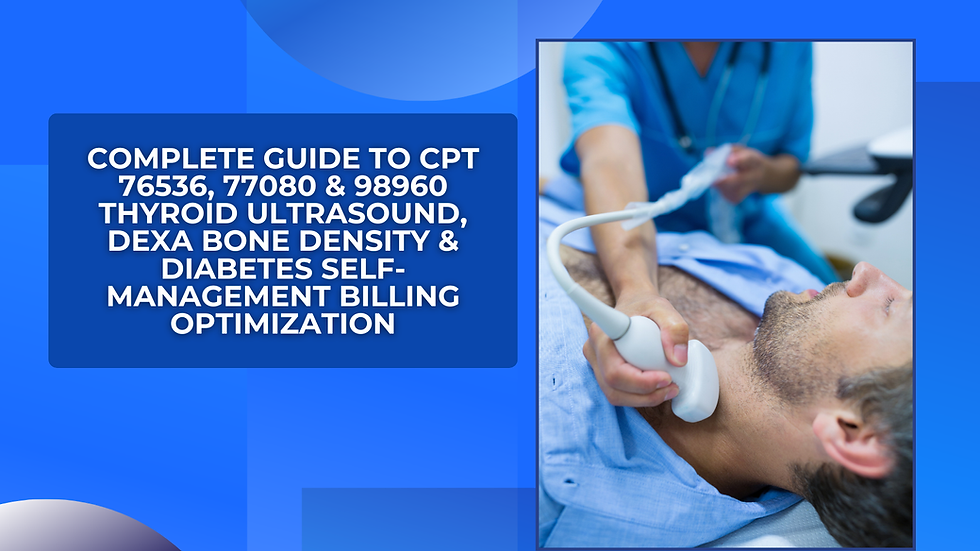
INTRODUCTION
Three Endocrinology Services That Drive Revenue When Billed Correctly
There is a pattern we see repeatedly when endocrinology practices reach out for billing help. They are performing thyroid ultrasounds, ordering DEXA scans, and providing diabetes self-management education regularly sometimes dozens of times per week. But when we pull their billing data, the reimbursement on these services is inconsistent, the denial rates are higher than they should be, and in many cases, services that should have been billed were never captured at all.
CPT 76536, 77080, and 98960 represent three distinct revenue streams in endocrinology imaging, diagnostic testing, and patient education and each one has its own billing rules, documentation requirements, frequency limitations, and payer quirks. Treating them as straightforward codes to submit without specialty-specific knowledge is one of the most reliable ways to leave money on the table.
This guide covers each code in depth: what it covers clinically, what documentation it requires, where the denial triggers are, and what billing strategies consistently improve reimbursement. If your practice is performing any of these services and not collecting on them at the rate you should be, this is the resource that will show you why.
💡 What This Guide Covers A complete, practical billing reference for thyroid ultrasound (CPT 76536), DEXA bone density scanning (CPT 77080), and diabetes self-management training (CPT 98960) — written by an endocrinology billing team with direct experience managing these codes across multiple payer environments. |
QUICK REFERENCE — ALL THREE CODES
CPT 76536, 77080 & 98960 Side-by-Side Comparison
Before diving into the details of each code, this table gives you a fast overview of what each covers, who can bill it, the approximate Medicare reimbursement, and the primary denial risk for each one.
CPT 76536 — THYROID ULTRASOUND
CPT 76536: Thyroid Ultrasound Billing — Everything Your Practice Needs to Know
Thyroid ultrasound is one of the most frequently performed diagnostic procedures in endocrinology, and CPT 76536 soft tissue ultrasound of the neck including thyroid and parathyroid glands is the code that drives that revenue. Getting the billing right on 76536 requires understanding the documentation standards, the component billing rules, and the payer-specific requirements that vary more than most practices realize.
What CPT 76536 Actually Covers
CPT 76536 covers a real-time ultrasound examination of the soft tissues of the neck, including the thyroid gland, parathyroid glands, and adjacent soft tissue structures. It is the appropriate code for thyroid nodule evaluation, nodule surveillance, post-thyroidectomy monitoring, and characterization of thyroid gland abnormalities. It is not the appropriate code when ultrasound is used solely for guidance during a biopsy procedure that is CPT 76942 (ultrasound guidance for needle placement).
Documentation Requirements for CPT 76536
✔ A formal written radiology-style report documenting the examination findings not just a notation in the encounter note that ultrasound was performed
✔ Specific measurements of any identified nodules including size in at least two dimensions, location within the gland, echogenicity, margins, vascularity, and calcification characteristics if present
✔ Assessment using a standardized reporting system such as ACR TIRADS or ATA guidelines classification increasingly required by payers as evidence of structured evaluation
✔ The clinical indication for the study the specific diagnosis or symptom driving the imaging order, linked to a covered ICD-10 code
✔ Documentation of who performed and who interpreted the study if different providers relevant for component billing
✔ Storage of images in the permanent medical record digital image storage is a requirement for most payers and a prerequisite for any future comparison studies
Professional vs Technical Component Billing for 76536
This is where many endocrinology practices lose revenue or create compliance exposure. CPT 76536 has both a technical component and a professional component. How your practice bills depends entirely on the equipment ownership and interpretation arrangements in your practice.
Common Billing Mistakes for CPT 76536
❌ Billing the global code when the practice only interprets images taken elsewhere this bills for technical work not performed by your practice
❌ Submitting 76536 without a formal written report — a brief mention of ultrasound findings in the progress note is not sufficient for payer requirements
❌ Billing 76536 and 76942 for the same service — when ultrasound is used exclusively for biopsy guidance, 76942 is correct; 76536 should only be billed if a separate diagnostic evaluation was performed
❌ Missing nodule measurements in the report — payers require specific size documentation; a report that says 'thyroid nodule noted' without measurements is a medical necessity denial waiting to happen
❌ Using the wrong ICD-10 code for the indication — E04.1 for single nontoxic nodule, E04.2 for multinodular goiter, E06.3 for autoimmune thyroiditis — specificity matters for every thyroid ultrasound claim
💡 Pro Tip: TIRADS Documentation Protects Your 76536 Claims Practices that use ACR TIRADS (Thyroid Imaging Reporting and Data System) or ATA risk classification in their ultrasound reports have significantly lower denial rates for CPT 76536. This structured reporting approach gives payers the specific clinical information they need to confirm medical necessity — and it doubles as audit protection because the risk stratification documents why follow-up or biopsy was or was not recommended based on objective criteria. Build TIRADS into your thyroid ultrasound report template. |
📋 Schedule a Free 76536 Billing Audit Find out if your thyroid ultrasound billing is capturing every dollar it should — with zero commitment required. |
CPT 77080 — DEXA BONE DENSITY
CPT 77080: DEXA Bone Density Billing — Frequency Rules, Documentation & Denial Prevention
DEXA bone density scanning is a core service in endocrinology for patients with osteoporosis, hyperparathyroidism, glucocorticoid-induced bone loss, and other conditions affecting skeletal integrity. CPT 77080 — dual-energy X-ray absorptiometry of the axial skeleton — drives meaningful reimbursement when billed correctly. But it is also one of the codes with the most payer-specific frequency rules, and violating those rules is the most consistent source of denials for this code.
What CPT 77080 Covers and What It Does Not
CPT 77080 covers DXA measurement of the axial skeleton, which typically means the hip and lumbar spine. It does not cover peripheral DXA of the wrist or heel those use different codes (CPT 77081 for peripheral, CPT 77082 for vertebral fracture assessment). Billing 77080 when a peripheral measurement was performed is an incorrect code selection that creates both a denial and a compliance risk.
Medicare Frequency Rules for CPT 77080
✔ Medicare covers DEXA scans once every 24 months for patients who meet medical necessity criteria this is a hard frequency limit that requires specific ICD-10 diagnosis coding to justify
✔ More frequent testing is covered when there is documented clinical justification monitoring response to osteoporosis treatment, significant change in clinical status, or newly initiated or discontinued medications affecting bone density
✔ Certain high-risk clinical situations justify more frequent testing: patients starting or stopping glucocorticoid therapy, patients newly diagnosed with primary hyperparathyroidism, patients with documented vertebral fractures, and women with newly confirmed estrogen deficiency
✔ The 24-month limitation is measured from the date of service of the prior DEXA, not from the date the prior result was reviewed billing systems need to track service dates, not result review dates
ICD-10 Codes That Support CPT 77080 Medical Necessity
Clinical Situation | Primary ICD-10 Code | Supporting Code(s) | Frequency Supported |
Osteoporosis screening — postmenopausal woman | Z13.820 | Z00.00 or preventive visit code | Once per 24 months under Medicare |
Established osteoporosis monitoring | M81.0 (postmenopausal) or M81.8 | Z79.83 (bisphosphonate use if applicable) | Every 24 months standard; more frequent with clinical justification |
Glucocorticoid-induced osteoporosis | M81.8 or M80.08xA | Z79.52 (long-term systemic steroids) | Every 12 months with documented steroid duration and dose |
Primary hyperparathyroidism | E21.0 | M81.8 or Z13.820 | At diagnosis; annually with documented disease progression |
Hypogonadism / estrogen deficiency | E28.39 or E23.0 | M81.8 or applicable bone loss code | Every 24 months or more frequent with clinical justification |
Post-bariatric surgery malabsorption | K91.2 | M81.8 or Z87.39 | Annually with documented malabsorption and nutritional risk |
Documentation Requirements for CPT 77080
✔ A formal DXA report with T-scores and Z-scores for each measured site hip (femoral neck and total hip) and lumbar spine at minimum
✔ The specific clinical indication for the scan linked to a documented diagnosis in the patient's record
✔ For repeat scans within 24 months: explicit documentation of the clinical reason justifying earlier repeat testing
✔ For Medicare: an order from the treating physician must be present — DXA cannot be ordered by non-physician staff for Medicare patients without physician co-signature
✔ Equipment calibration documentation payers increasingly request evidence that the DXA machine is properly maintained and calibrated; keep maintenance logs current
✔ Comparison to prior scans when available document whether bone density has improved, declined, or remained stable relative to the previous study
⚠️ Revenue Leak Alert: The 24-Month Rule Is the Most Violated Billing Rule in DEXA The most common denial we see for CPT 77080 is straightforward: the scan was performed before the 24-month coverage window had elapsed and the claim was submitted without documented clinical justification for earlier testing. The fix is a scheduling workflow that flags the prior DEXA date for every patient and requires clinical documentation review before a repeat scan is booked. One workflow change eliminates the majority of DEXA denials. |
Revenue Optimization Strategies for CPT 77080
✔ Track prior DEXA dates in your scheduling system and build a coverage window calculation into your booking workflow prevents frequency denials before they occur
✔ For patients who need more frequent scanning, document the clinical justification explicitly in the ordering note before the scan is performed — not added retroactively after a denial
✔ Verify whether your practice bills the global code (77080) or needs to split technical and professional components based on equipment ownership and interpretation arrangements
✔ Identify patients in your panel who are overdue for DEXA scanning — particularly postmenopausal women over 65, patients on long-term steroids, and patients with hyperparathyroidism — and implement a systematic recall protocol
✔ Use the most specific ICD-10 code available for each patient's bone health status specificity supports medical necessity and reduces the risk of frequency-based denials
CPT 98960 — DIABETES SELF-MANAGEMENT TRAINING
CPT 98960: Diabetes Self-Management Training — The Most Under-Billed Endocrinology Code
Here is a fact that surprises most endocrinology practices: CPT 98960 is one of the most consistently under-billed codes in the specialty. Nearly 70 percent of endocrinology practices that provide some form of diabetes education are not capturing the full reimbursement available under the DSMT billing framework either because they do not have the required program accreditation, because their educators are not billing correctly, or because nobody in the practice has ever built a compliant 98960 billing workflow.
CPT 98960 covers self-management education and training for patients with an established illness or condition specifically, individual sessions of 30 minutes face-to-face with a qualified non-physician healthcare professional. In the context of diabetes, it covers the one-on-one education sessions that certified diabetes care and education specialists, registered dietitians, and other qualified educators provide under an ADA-accredited DSMT program.
Who Can Bill CPT 98960 — and the ADA Accreditation Requirement
This is the most common source of billing confusion for 98960. The code itself is not restricted to physicians, but the program providing the education must be accredited by the American Diabetes Association or another recognized accrediting body accepted by the payer. Individual educators or practices that provide diabetes education without formal program accreditation cannot bill 98960 under Medicare and most commercial payers.
The good news is that ADA program accreditation is obtainable for endocrinology practices that have the clinical infrastructure to support it. The process takes several months but unlocks a significant revenue stream for practices with the right patient population and educator staffing.
Eligible Providers and Time Requirements for CPT 98960
Requirement | CPT 98960 Details | Compliance Risk If Not Met |
Session type | Individual (one patient, one educator) — group sessions use CPT 98961 and 98962 | Billing 98960 for group sessions generates incorrect reimbursement and potential false claims exposure |
Minimum time | 30 minutes of face-to-face education time per session | Billing a unit of 98960 for less than 30 minutes of documented education is a documentation integrity violation |
Eligible educators | Certified Diabetes Care and Education Specialist (CDCES), Registered Dietitian with diabetes education training, registered nurse with appropriate certification, pharmacist with certified training | Education provided by non-qualified staff without appropriate certification is not billable under 98960 |
Program accreditation | ADA-recognized DSMT program or equivalent payer-accepted accreditation required for Medicare billing | Without program accreditation, 98960 claims are non-covered under Medicare and many commercial payers |
Physician referral | Medicare requires a physician referral documenting the diagnosis of diabetes and medical necessity for DSMT | Missing or informal referral without documented diagnosis is a Medicare denial trigger for 98960 claims |
Annual limits | Medicare covers up to 10 hours of DSMT in the initial year and 2 hours per year in follow-up years | Billing beyond annual hour limits without documented medical necessity for additional services generates frequency denials |
Documentation Requirements for CPT 98960
✔ The patient's diabetes diagnosis documented with a specific ICD-10 code in the referral and the session record E11.xx for T2 diabetes, E10.xx for T1 diabetes, with complication codes as applicable
✔ The educator's credential documented in the session note their certification type and the program under which they are providing the education
✔ The program's ADA accreditation number or accrediting body documentation this protects the claim if a payer requests proof of program qualification
✔ Start and end time of the education session required to document the 30-minute minimum and to support billing of multiple units when sessions exceed 30 minutes
✔ The specific education content covered in the session glucose monitoring technique, medication management, foot care, nutrition counseling, hypoglycemia recognition and treatment, or other covered topics
✔ The physician referral or order authorizing the DSMT services Medicare specifically requires this and many commercial payers follow the same standard
✔ Patient attendance documented by the patient's signature or equivalent attestation for each session
💡 Pro Tip: The Follow-Up Unit Is the Most Missed Revenue in DSMT Billing Most practices that do bill 98960 capture the initial year DSMT sessions reasonably well. What consistently goes uncaptured are the follow-up units — the 2 hours per year of ongoing DSMT that Medicare covers for established diabetes patients in subsequent years. These follow-up sessions require a physician order, an educator session note, and the same documentation standards as initial sessions. For a practice with 200 active diabetes patients eligible for follow-up DSMT, the annual revenue from these sessions at approximately $30 to $55 per 30-minute unit represents a meaningful and recurring revenue stream that most practices are simply not billing. |
✅ DSMT Billing Best Practices ✔ Obtain and maintain ADA program accreditation — without it, 98960 is not billable under Medicare regardless of educator credentials ✔ Document start and end time for every education session time is the unit of billing for this code ✔ Include educator credential type in every session note — CDCES, RD, or other qualifying credential must be identified ✔ Track annual DSMT hour usage per patient — Medicare annual limits generate denials when exceeded without documented medical necessity ✔ Obtain a physician referral with documented diabetes diagnosis before initiating any DSMT billing ✔ Implement a recall system for follow-up DSMT — the two annual follow-up hours are high-recovery, low-effort revenue | ❌ DSMT Billing Mistakes to Avoid ❌ Do not bill 98960 for education provided by staff without appropriate certification — unlicensed education is not a covered service ❌ Do not bill 98960 without ADA program accreditation for Medicare patients the claim is not covered without it ❌ Do not bill 98960 for group sessions individual and group DSMT use different codes (98961 for 2 to 4 patients, 98962 for 5 to 8 patients) ❌ Do not document DSMT time vaguely — 'approximately 45 minutes' is not sufficient; document start and end times explicitly ❌ Do not bill beyond Medicare annual hour limits without documented medical necessity for additional sessions ❌ Do not miss the physician referral requirement — this is a hard Medicare requirement that generates denials when absent |
📈 Improve Your DSMT Billing Revenue Our team helps endocrinology practices build compliant CPT 98960 billing workflows that capture the full reimbursement your educators earn. |
DENIAL PREVENTION CHECKLIST
Master Denial Prevention Checklist for CPT 76536, 77080 & 98960
These three codes share a common thread in their denial patterns: most denials trace back to documentation gaps that were preventable at the point of service. This checklist gives you the pre-submission verification points that eliminate the majority of denials for all three codes.
END-TO-END BILLING WORKFLOW
Step-by-Step Billing Workflow for CPT 76536, 77080 & 98960
HOW SPECIALIZED BILLING IMPROVES REVENUE
How Specialized Endocrinology Billing Services Improve Revenue on These Codes
The billing rules for CPT 76536, 77080, and 98960 are not complicated in principle. But applying them consistently across every claim, every payer, and every provider in your practice requires specialty-specific knowledge, payer-specific claim scrubbing rules, and documentation workflows that most in-house billing teams are not equipped to maintain on their own.
The practices that collect the most on these three codes are the ones where billing expertise is built into the process rather than applied after denials arrive. That is the difference a specialized endocrinology billing partner makes.
✅ What MedCloudMD Delivers for These Codes ✔ Payer-specific claim scrubbing rules for 77080 frequency limits built into pre-submission review — denials prevented before they happen ✔ Component billing expertise for 76536 — correct global, TC, and 26 modifier application based on each practice's equipment and interpretation arrangements ✔ DSMT billing workflow design for 98960 — educator documentation templates, time tracking, annual limit monitoring, and ADA accreditation compliance support ✔ Monthly denial pattern analysis with root cause identification and corrective action workflows ✔ Real-time reporting on denial rates, collection performance, and reimbursement trends by code and payer ✔ Documentation coaching for imaging reports and education session notes that prevent medical necessity denials | ⚠️ What In-House Teams Typically Struggle With ⚠️ Tracking prior DEXA service dates across payers with different frequency calculation methods and coverage window definitions ⚠️ Managing component billing decisions for 76536 that change based on referral source, equipment ownership, and interpretation arrangements ⚠️ Building and maintaining a compliant 98960 billing workflow that captures initial and follow-up DSMT revenue while tracking annual hour limits ⚠️ Keeping up with MAC LCD updates for thyroid imaging and bone density scanning that change frequency and documentation standards ⚠️ Identifying under-billed services — particularly follow-up DSMT and DEXA surveillance recalls that represent significant but uncaptured revenue ⚠️ Appealing documentation-based denials with clinical rationale that requires both billing and endocrinology-specific knowledge |
FREQUENTLY ASKED QUESTIONS
FAQ — CPT 76536, 77080 & 98960 for Endocrinology Billing
Q1: Can an endocrinologist bill CPT 76536 for interpreting a thyroid ultrasound performed at a hospital?
Yes, with Modifier 26 appended to the code. When your endocrinologist provides a formal written interpretation of a thyroid ultrasound performed at a hospital or imaging center that owns the equipment, you bill CPT 76536-26 for the professional component of that interpretation. The hospital or imaging center bills the technical component under their NPI. The interpretation must be documented as a formal written report not simply a notation in the encounter note that results were reviewed. This is a legitimate revenue stream that many endocrinology practices are not capturing because they assume interpretation of studies performed elsewhere is not billable.
Q2: How often can an endocrinology practice bill CPT 77080 for a Medicare patient with osteoporosis?
Under standard Medicare coverage, CPT 77080 is covered once every 24 months for patients who meet medical necessity criteria. More frequent testing is covered when there is documented clinical justification monitoring response to newly initiated bisphosphonate or denosumab therapy, evaluating patients with glucocorticoid-induced bone loss, assessing patients with newly diagnosed primary hyperparathyroidism, or any clinical situation where a change in treatment decision depends on updated bone density measurement. The justification must be in the ordering physician's note at the time the scan is ordered, not added retroactively after a denial is received.
Q3: Does CPT 98960 require a physician referral for Medicare patients?
Yes. Medicare requires a physician referral documenting the diabetes diagnosis and the medical necessity for diabetes self-management training before 98960 services can be billed. The referral must come from the patient's treating physician or other qualified provider it cannot be self-referred by the educator or the DSMT program. The referral must document the specific diabetes diagnosis (E10.xx, E11.xx, or applicable code) and state that DSMT is medically necessary. Many DSMT claims are denied under Medicare because the referral is informal, undocumented, or made by a non-qualified provider. The fix is a standardized referral process that generates a written physician order before any education sessions begin.
Q4: What is the difference between CPT 98960, 98961, and 98962 for diabetes education billing?
These three codes differ only in the number of patients present during the education session. CPT 98960 covers individual DSMT sessions — one patient, one educator, 30 minutes minimum. CPT 98961 covers group sessions with 2 to 4 patients. CPT 98962 covers group sessions with 5 to 8 patients. All three require the same ADA program accreditation, physician referral, and educator qualification standards. Group sessions have lower per-patient reimbursement rates but allow the practice to generate revenue from multiple patients simultaneously. Billing 98960 for what was actually a group session is an incorrect code selection that creates compliance exposure.
Q5: Can CPT 76536 and CPT 76942 be billed on the same date of service?
Yes, but only when both a diagnostic thyroid ultrasound and ultrasound-guided needle placement were performed as genuinely separate services. If your endocrinologist performs a complete diagnostic thyroid ultrasound evaluating nodule characteristics, and then separately uses ultrasound guidance to perform a thyroid biopsy (CPT 60100), billing both 76536 and 76942 with Modifier 59 to indicate distinct procedural services is appropriate and supported when both services are separately documented. However, if the only ultrasound performed was for real-time guidance during the biopsy, only 76942 should be billed 76536 cannot be billed for guidance-only imaging.
Q6: What ICD-10 codes are most important for supporting CPT 77080 medical necessity?
The ICD-10 codes that most reliably support 77080 medical necessity include M81.0 for postmenopausal osteoporosis, M81.8 for other osteoporosis, E21.0 for primary hyperparathyroidism, E28.39 for ovarian failure with associated bone loss, Z79.52 for long-term systemic steroid use relevant to glucocorticoid-induced bone loss, and Z13.820 for screening examination for osteoporosis. For patients being monitored after starting treatment, adding Z79.83 for bisphosphonate use or the specific medication management code strengthens the medical necessity case. Always select the most specific code available for each patient's documented condition avoid unspecified osteoporosis codes when a more specific option exists.
Q7: How does Medicare calculate the annual hour limit for CPT 98960 DSMT billing?
Medicare covers up to 10 hours of DSMT in the initial benefit year — the first calendar year after the physician referral is made. In subsequent years, Medicare covers up to 2 hours of follow-up DSMT per calendar year. Each unit of CPT 98960 represents 30 minutes of individual education time, so the initial year benefit covers 20 units and the annual follow-up benefit covers 4 units. Hours cannot be carried forward from one year to the next. Billing beyond these annual limits without documented medical necessity for additional sessions results in frequency denials. Track each patient's annual DSMT utilization in your billing system and implement alerts when patients approach their coverage limits.
Q8: What are the most common audit triggers for endocrinology practices billing these three codes?
For CPT 76536, the most common audit trigger is a high volume of global code billing without documentation that the practice actually owns the ultrasound equipment and provides the physician interpretation this suggests potential billing for services not performed. For CPT 77080, audit attention is attracted by DEXA scanning frequencies significantly above the Medicare standard, particularly when the claims lack documented clinical justification for early repeat testing. For CPT 98960, the audit triggers are DSMT claims submitted without evidence of ADA program accreditation and claims exceeding annual hour limits without medical necessity documentation. The mitigation for all three is the same thorough contemporaneous documentation, code-level denial tracking, and quarterly internal billing audits.
CONCLUSION AND NEXT STEP
The Revenue You Are Missing on These Three Codes Is Recoverable
CPT 76536, 77080, and 98960 are not obscure codes. They represent services that endocrinology practices perform every week thyroid imaging, bone density monitoring, and diabetes education. The revenue gap on these codes is not caused by the clinical work not happening. It is caused by billing workflows that do not fully capture the documentation, the correct modifiers, the right components, or the annual service utilization that each code supports.
The practices that close this gap consistently have one thing in common: they treat these codes as specialty billing challenges that require specialty billing expertise not general medical billing process applied to endocrinology-specific services. Whether that expertise is built in-house or brought in through a specialized billing partner, the investment consistently delivers measurable revenue improvement.
MedCloudMD works specifically with endocrinology practices on exactly these billing challenges. Our team starts every new client engagement with a free billing audit that shows you the actual performance numbers on your current claims denial rate by code, collection rate versus contracted rate, and a clear picture of where the revenue opportunity is. No commitment required to get that picture.
Free Endocrinology billing audit for practices billing these three codes | 48hrs Typical turnaround for audit findings and revenue assessment report | HIPAA Fully compliant audit process and data handling | $0 Commitment required to request your billing performance review |
🚀 Request Your Free Endocrinology Billing Audit Let us show you exactly what your current billing performance looks like on CPT 76536, 77080, and 98960 — and where the revenue recovery opportunity is. |


Comments