
CPT 92511 Nasopharyngoscopy Billing: The Complete 2026 Coding, Documentation & Reimbursement Guide

Updated: Jul 29
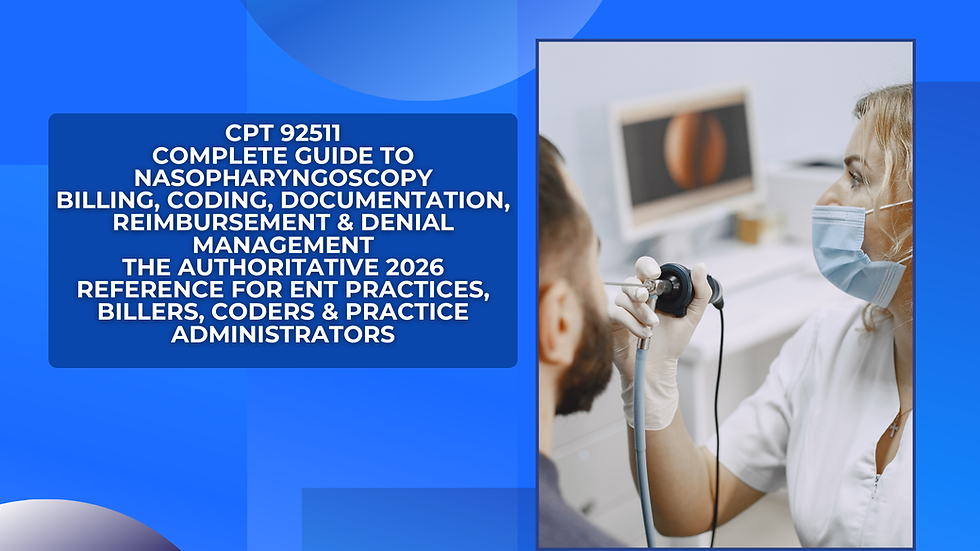
CPT 92511 looks simple on paper: a flexible scope, a quick nasopharyngeal exam, a straightforward diagnostic code. In practice, it's one of the more error-prone codes in ENT billing, not because the procedure is complicated, but because of three words in its own description: "separate procedure." That label controls whether 92511 gets paid on its own, gets bundled into a same-day scope, or gets denied outright, and most denials trace back to a note that never resolves the question.
This guide covers what CPT 92511 actually covers, how it compares to the ENT endoscopy codes it's most often confused with, the modifiers that determine whether it's separately payable, and the documentation payers are actually looking for in 2026.
What CPT 92511 Covers, and Why "Separate Procedure" Is the Whole Ballgame
CPT 92511 describes nasopharyngoscopy performed with an endoscope: a flexible scope passed transnasally to examine the nasal cavity, nasopharynx, and related structures. It's a diagnostic procedure, visualization only, with no biopsy and no therapeutic intervention. The moment a provider takes therapeutic action during that same scope session, the encounter typically needs to be coded differently, not as 92511.
The "(separate procedure)" label in the CPT description doesn't mean the code can never be billed with another procedure. It means payers treat it as bundled into more extensive related procedures unless the documentation shows it addressed a distinct clinical question. Billed alone, that label rarely causes a problem. Billed alongside another endoscopic ENT code in the same session, it's exactly what a payer's system checks first.
Did You Know? CPT 92511 and CPT 92510 are easy to mix up but code very different encounters. 92511 is diagnostic visualization only. 92510 applies when a therapeutic procedure, like a biopsy, is performed during the same nasopharyngoscopy. Billing 92511 when the encounter actually included an intervention is a common, avoidable coding error. |
The CPT 92511 Billing Workflow
Getting paid for a nasopharyngoscopy claim consistently comes down to following the same sequence:

Not sure your CPT 92511 claims are documented the way payers expect? Talk to our ENT billing specialists. |
CPT 92511 vs. Similar ENT Endoscopy Codes
Modifier Decision Guide for CPT 92511
Modifier | When to Use | Billing Scenario |
25 | Significant, separately identifiable E/M same day | Patient is seen for a new complaint, the exam supports a distinct E/M, and the scope happens at the same visit |
59 / XS | 92511 is distinct from another endoscopic procedure same session | Nasopharyngoscopy and a flexible laryngoscopy are both performed with separately documented indications and findings |
52 | Reduced services | The exam was medically limited or incomplete, and that limitation is documented |
GA | Waiver of liability (ABN) on file | Medical necessity is uncertain and the patient signed an ABN before the procedure |
Quick Tip When 92511 is billed with another endoscopic code, using a specific modifier like XS instead of the generic 59 gives the payer less reason to flag the claim for manual review. | ||
Documentation & Compliance Checklist
Category | What the Note Needs |
Clinical Indication | The specific reason the scope was needed, not "patient referred for evaluation" |
Prior Workup | What was tried or assessed before the scope, when relevant to necessity |
Scope Findings | Positive findings and confirmed normal structures, not just a procedure description |
Distinct Documentation | A separate findings section when billed alongside another endoscopic code |
Physician Attestation | Identity, signature, and date on the note before the claim goes out |
Authorization | Confirmed prior auth where the payer requires it for diagnostic endoscopy |
Coding Match | An ICD-10 code specific enough to support necessity, not a symptom code alone |
Why CPT 92511 Claims Get Denied
Reason | What's Actually Happening |
"Not Medically Necessary" | The note describes the procedure but never states why it was clinically required |
Bundling Denials | 92511 billed with another scope code, no modifier, no distinct documentation |
Missing Modifier 25 | Same-day E/M billed without the modifier that separates it from the procedure |
Cloned Documentation | Template language repeated across notes with no patient-specific findings |
Authorization Gaps | Scope performed before confirming payer-specific prior auth requirements |
Wrong Code Selected | 92511 billed when the session actually included a therapeutic intervention |
Common Mistake Billing 92511 and 31575 on the same claim without a distinct findings section for each is one of the fastest ways to trigger a bundling denial, even when both scopes were genuinely necessary. | |
Medicare vs. Commercial Insurance Considerations
Traditional Medicare generally covers CPT 92511 without prior authorization when medical necessity is documented, guided by Medicare Administrative Contractor coverage policy. Commercial payers and Medicare Advantage plans set their own rules, and many require prior authorization for diagnostic endoscopy, particularly without a documented prior, more conservative assessment. Confirm requirements payer by payer rather than assuming Medicare's rules apply across the board.
Compliance, Audit Readiness & Revenue Protection
Internal review matters as much as the initial claim. A regular audit sample, checking a handful of nasopharyngoscopy notes each quarter against your documentation checklist, catches drift before it becomes a denial pattern. The most common audit findings mirror the most common denials: vague indications, missing distinct documentation on paired procedures, and modifier 25 left off a same-day E/M. Fixing those consistently protects revenue more reliably than appealing denials after the fact.
Bundling denials eating into your ENT collections? Request a free revenue cycle assessment. |
Why ENT Practices Outsource CPT 92511 Billing
Why Choose MedCloudMD
ENT coding rewards specialization, especially on a code like 92511 where the difference between paid and denied often comes down to one missing sentence in the note. Our coders work ENT claims specifically, so they know when a scope genuinely supports a distinct modifier and when it doesn't, and they know what a payer's reviewer is looking for before a claim goes out. We track CPT, NCCI, and payer-specific updates as they're released, and we stay transparent about claims status and AR performance at every step. HIPAA-compliant processes and clear communication aren't extras here. They're the baseline.
When to Contact a Billing Expert If nasopharyngoscopy denials keep landing on "not medically necessary," your same-day E/M capture feels inconsistent, or your team isn't confident choosing between 92511, 31231, and 31575, it's worth a second set of eyes before more revenue slips through. |
Frequently Asked Questions
Click the arrow beside any question in Word's outline view to expand or collapse it.
What does CPT 92511 cover?
CPT 92511 describes a diagnostic nasopharyngoscopy: a flexible endoscope passed transnasally to examine the nasal cavity and nasopharynx. It's visualization only. If the provider performs a biopsy or other therapeutic action during the same session, CPT 92510 applies instead.
Can CPT 92511 be billed with CPT 31575 on the same day?
Yes, when each procedure addresses a distinct clinical question and the note documents separate findings for each. Without that distinct documentation and the appropriate modifier, such as 59 or XS, payers typically treat the two as bundled and deny one.
What's the difference between CPT 92511 and CPT 31231?
Both are diagnostic nasal endoscopy codes labeled "separate procedure," but they sit in different sections of the CPT code set with different conventions. Confirm which matches the anatomy actually examined and your payer's specific preference.
Why do CPT 92511 claims get denied for medical necessity?
Usually because the note describes the procedure without stating why it was clinically required. Payers want to see the specific question the scope answered, not just confirmation that it was performed.
Does CPT 92511 require prior authorization?
It depends on the payer. Traditional Medicare typically doesn't require it when medical necessity is documented, but many Medicare Advantage and commercial plans do, especially without a documented prior, more conservative assessment.
Can a nurse practitioner or physician assistant bill CPT 92511?
In many cases, yes, when the provider is credentialed for the service, operating within their state's scope of practice, and the payer's rules allow it. Requirements vary enough that it's worth confirming before relying on it.
What documentation does a CPT 92511 claim need?
A specific clinical indication, the scope approach, anatomic findings including confirmed normal structures, and a signed, dated physician attestation. If billed with another endoscopic code, the note needs separately documented findings for each.
Should ENT practices outsource CPT 92511 billing?
Practices with recurring bundling denials, inconsistent modifier use, or no staff dedicated to ENT-specific coding often see a meaningful improvement after partnering with a specialty-focused billing team.
Final Thoughts
CPT 92511 isn't a complicated procedure to perform, but billing it well takes real attention to a few specific decision points: is this diagnostic or therapeutic, is it truly distinct from another same-day scope, and does the note say why it mattered. Get those right consistently, and denials on this code become the exception instead of the pattern.
Disclaimer This content is provided for educational and informational purposes only and should not be considered legal, coding, reimbursement, or medical advice. Billing regulations, CPT® coding, National Correct Coding Initiative (NCCI) edits, CMS policies, and payer requirements may change over time and can vary by payer and location. Healthcare providers should verify current coding guidelines and reimbursement policies with the appropriate payer, CMS, AMA CPT® resources, or qualified coding professionals before submitting claims. MedCloudMD provides professional medical billing and revenue cycle management services to support healthcare organizations but does not guarantee reimbursement outcomes. |


Comments