
Texas Medicaid Behavioral Health Fee Schedule 2026: Outpatient Rates & Billing Guide


The Texas Medicaid behavioral health fee schedule is the state's published list of fee-for-service rates for outpatient mental health services. It is published by the Texas Medicaid & Healthcare Partnership (TMHP) for the Texas Health and Human Services Commission (HHSC), and it is the first place to look when you need to know what a service may pay.
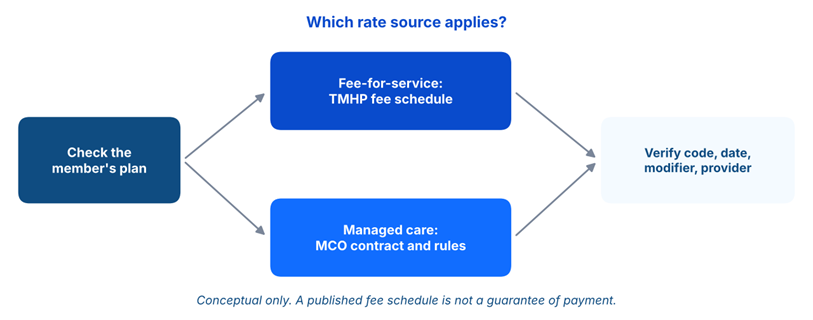
It is not the last word, though. Many Texas Medicaid members are served through managed care organizations (MCOs) that pay under their own contracts and rules. This guide shows how to find the right 2026 source, verify a rate yourself, and avoid the billing errors that most often lead to denials. We do not list dollar amounts here because rates change by revision and plan, and a number copied into a blog is easy to get wrong. Verify every rate in the official source.
Key takeaways 1. Start with the member's plan: fee-for-service or managed care. 2. Read the date on the fee schedule header and use the version that matches the date of service. 3. A published rate is not a guaranteed payment. 4. Provider type, modifiers, authorization, and documentation all affect payment. 5. Review denials by reason to fix repeat problems. |
What Is the Texas Medicaid Behavioral Health Fee Schedule?
It lists procedure codes with the maximum fee-for-service reimbursement Texas Medicaid has set for covered outpatient behavioral health services. Whether a service is covered, who can bill it, and how often it can be billed are governed by the Texas Medicaid Provider Procedures Manual (TMPPM). The fee schedule answers one question only: what is the published rate?
The rate that reaches your bank account depends on coverage, provider qualifications, modifiers, authorization, place of service, and the payer arrangement. Under managed care, that payer arrangement is the MCO contract.
Where to Find Texas Medicaid Behavioral Health Rates for 2026
Step 1 | Confirm whether the member's coverage is fee-for-service or a managed care plan. |
Step 2 | For fee-for-service, open the Outpatient Behavioral Health fee schedule on the TMHP fee schedules page. |
Step 3 | Read the revision date at the top of the schedule. TMHP revises schedules during the year, so check you have the current version. |
Step 4 | Find the procedure code, then check the modifier, provider type, and any notes tied to that row. |
Step 5 | Cross-check coverage rules in the TMPPM Behavioral Health and Case Management Services Handbook. |
Step 6 | For managed care, use the MCO's own fee schedule, contract, and provider manual. |
Step 7 | Save a dated copy of what you used so you can compare it with the remittance later. |
Texas Medicaid Behavioral Health Outpatient Rates for 2026
We have not placed rates in a table because we cannot responsibly reproduce a changing fee schedule here. Use this verification table instead, and pull the rate directly from the TMHP fee schedules.
Actual reimbursement may differ based on coverage, provider qualifications, modifiers, authorization, place of service, MCO contracts, and payment policies. Any figure in your own spreadsheet should be labeled with its source and date.
Not sure which rate applies to your claims? Our team can help you compare expected rates with remittances and spot recurring payment gaps. Contact our team to discuss your behavioral health billing workflow → |
Common Outpatient Behavioral Health Billing Codes and Requirements
The October 2026 TMPPM Behavioral Health and Case Management Services Handbook lists the outpatient mental health codes below. Several are limited to specific diagnoses, which the handbook lists in its own tables. Select a code only for the service actually performed and documented, never because it pays more.
Code Group (per handbook) | Billing Considerations |
90791, 90792 | Psychiatric diagnostic evaluation; confirm which provider types may bill each |
90832–90838 | Psychotherapy; time and add-on rules must match documentation |
90846, 90847, 90853 | Family and group psychotherapy; confirm patient presence and documentation |
90870, 90899 | Other listed services; confirm coverage criteria before billing |
96116, 96121, 96130–96133, 96136, 96137 | Psychological and neuropsychological testing; confirm provider type and diagnosis limits |
The handbook lists physicians, physician assistants, APRNs, LCSWs, LMFTs, LPCs, psychologists, and other defined provider types, with some (such as licensed psychological associates) billing under a supervising psychologist or entity. For telehealth, the handbook describes modifier 95 for audiovisual services and modifier 93 for audio-only services, and some services cannot be completed audio-only. Confirm the specifics for your provider type and service.
Texas Medicaid Behavioral Health Billing Requirements
Check | What to Review |
Eligibility and coverage | Confirm active Medicaid and the member's plan on the date of service |
Provider enrollment | Rendering and billing provider enrollment and qualifications match the claim |
Covered benefits and limits | The handbook states a limit of 30 psychotherapy visits per calendar year for listed codes, with additional services requiring prior authorization |
Authorization or referral | Confirm requirements with TMHP rules or the MCO before the service |
Medical necessity | Documentation supports the diagnosis, service, and time billed |
Coding details | CPT/HCPCS, modifiers, units, and place of service match the note |
Timely filing | Check the deadline for your claim type in the TMPPM or MCO contract |
MCO-specific rules | Benefits, prior authorization, and claims rules may differ by plan |
Common Texas Medicaid Behavioral Health Claim Denials
Issue | What Happens | Prevention Step |
Eligibility or coverage | Member not active or in another plan | Verify eligibility and plan before each visit |
Wrong or unsupported code | Code does not match documentation | Coder review before submission |
Missing or wrong modifier | Telehealth or provider modifier omitted | Use a modifier checklist by service |
Incomplete documentation | Note lacks time, plan, or necessity | Template prompts and periodic audits |
Authorization or referral gap | Visits exceed limits without approval | Track visit counts and requirements |
Enrollment mismatch | Rendering provider not enrolled or not matched | Check enrollment and NPI use for supervised staff |
Duplicate claim or wrong units | Same service billed twice or units off | Claim scrubbing and unit checks |
Timely filing error | Claim submitted after the deadline | Work aging reports and track deadlines |
Wrong payer instructions | Fee-for-service rules used for an MCO claim | Route claims by plan first |
Not every denial can be avoided, but most of these are preventable with routine front-end and pre-submission checks.
How to Improve Outpatient Behavioral Health Reimbursement
• Verify benefits early. Eligibility and plan checks before the visit prevent the most avoidable rejections.
• Review claims before submission. A second look at codes, modifiers, units, and provider fields catches routine errors.
• Track denials by reason and payer. Patterns show what to fix upstream.
• Prioritize aging A/R. Work older balances before filing and appeal deadlines pass.
• Reconcile payments. Compare remittances with the dated rate you saved.
• Watch policy updates. Check TMHP and MCO notices for changes.
Consistent revenue cycle management can help find preventable errors and improve follow-up. It cannot guarantee a particular financial result.
Texas Medicaid Behavioral Health Billing Checklist
☐ | Member eligibility and plan confirmed for the date of service |
☐ | Rendering provider is enrolled and qualified for the service |
☐ | Service is covered and within visit limits |
☐ | Authorization or referral obtained if required |
☐ | Documentation supports the service, time, and necessity |
☐ | CPT/HCPCS code matches the service performed |
☐ | Modifiers applied where required, including telehealth |
☐ | Units and place of service are correct |
☐ | Payer instructions checked, including MCO rules |
☐ | Filing deadline noted |
Frequently Asked Questions
▸ Where can I find the Texas Medicaid behavioral health fee schedule for 2026? |
On the TMHP website under fee schedules. Look for the Outpatient Behavioral Health schedule and check its revision date. |
▸ Are rates the same for every provider? |
Not necessarily. Rates and eligibility can depend on provider type, modifier, and service. Check the schedule notes. |
▸ Do managed care plans use the same rates as fee-for-service? |
Not necessarily. MCOs pay under their own contracts and fee schedules, so check each plan. |
▸ Does every outpatient behavioral health service require prior authorization? |
No. Requirements depend on the service and plan. The handbook describes visit limits for some psychotherapy codes, with additional services requiring authorization. |
▸ How can a provider check whether a CPT code is covered? |
Review the TMPPM Behavioral Health handbook and the fee schedule, then confirm with the MCO for managed care members. |
▸ What should a clinic do after a claim is denied? |
Read the denial reason, correct what is fixable, and resubmit or appeal within the applicable deadline. Track the reason to prevent repeats. |
Disclaimer: This article is for general educational purposes only and is not legal, coding, reimbursement, or payer-specific advice. Fee schedules and Medicaid policies can change, and the details here may become outdated. Verify current requirements with official Texas Medicaid resources and the applicable managed care organization before submitting claims or making reimbursement decisions. MedCloudMD does not guarantee claim approval, reimbursement amounts, or specific financial results.


Comments